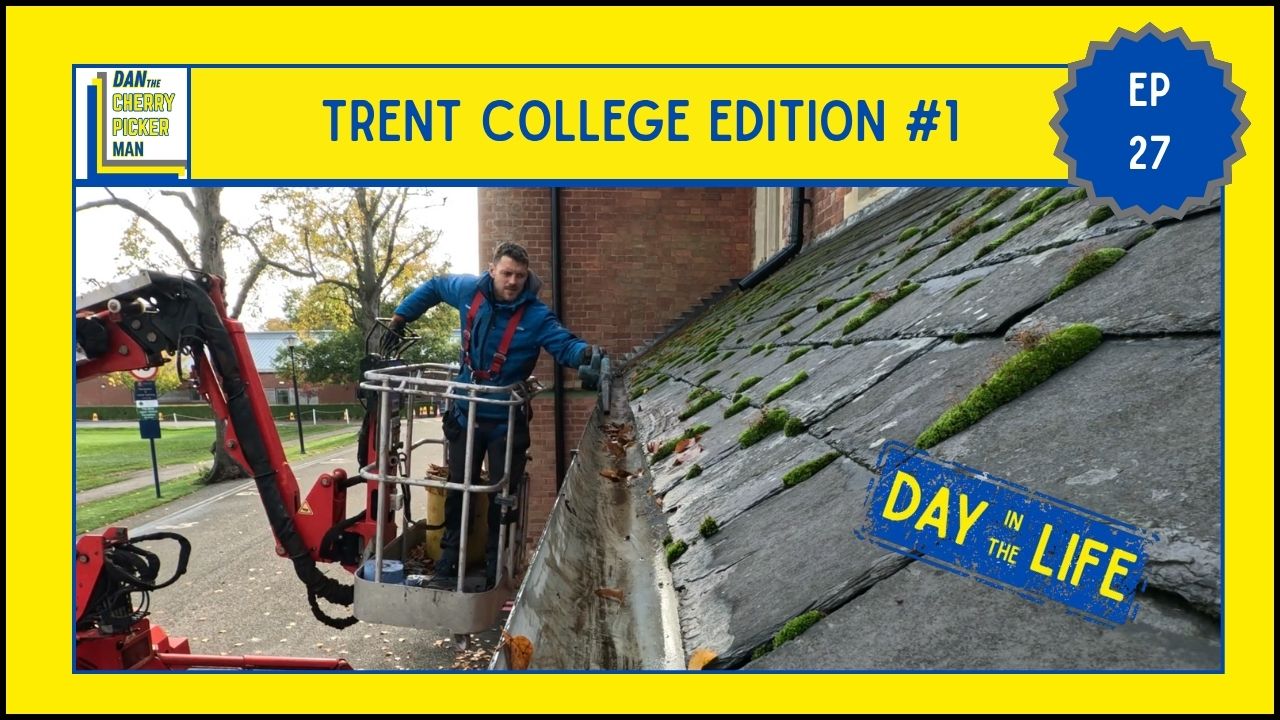
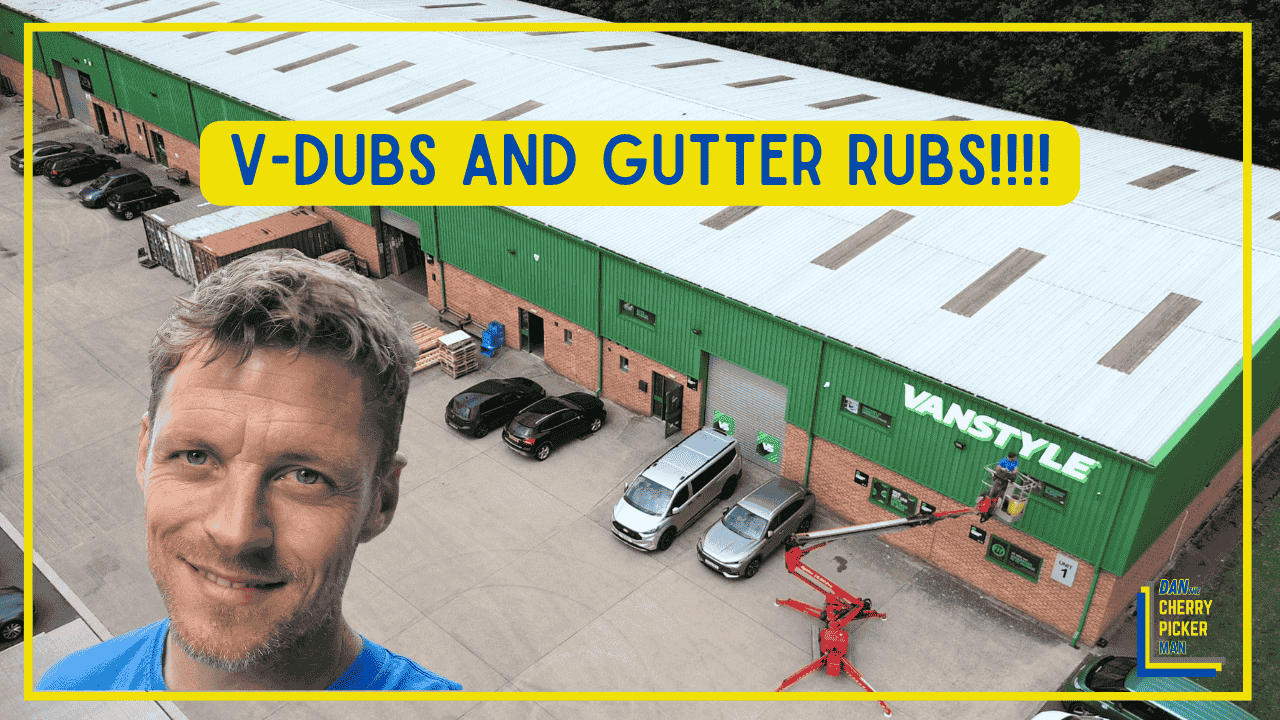
If you’ve ever wondered what it takes to keep a large student building watertight, this job was a good example.
I spent the day in West Bridgford, right in the heart of Nottingham, a stone’s throw from Trent Bridge, the cricket ground, the City Ground and Meadow Lane, working for a property management company on a student block with leaking gutters, slipped tiles and water damage showing up inside the building.
My brief was simple: get up there, make things safe, make things watertight, and patch the roof back together. Easier said than done when you’re working at height on a tight urban site with parked cars in every direction but that’s exactly the kind of job a tracked cherry picker was made for.
You can watch the whole job from start to finish here: 👉 Watch the full video on YouTube
The Problem: Leaking Gutters Causing Damage Inside the Building
A few weeks before this visit, I was asked to investigate problems with the gutters on this student block. Water was leaking through and causing damage inside the property which is always the point where a gutter problem stops being cosmetic and starts costing real money.
On top of that, the roof had a number of slipped tiles and damaged sections that needed sorting before they turned into leaks of their own.
Setting Up a Cherry Picker in a Tight Urban Spot
This was a tight setup. Parked cars everywhere, and no realistic way of tracking down the owners anyone who’s worked on flats or student accommodation will know that finding the owner of one particular car is a nuisance at best. Fortunately, I managed to position the machine without needing anyone to move, tracked in, set up, and cracked on.
This is one of the big advantages of cherry picker access on jobs like this. A tracked spider lift can squeeze into spaces that scaffolding simply can’t, set up in minutes rather than days, and be repositioned around the building as the work moves. On this job I set up in three different locations around the block — including narrowing the tracks right down to bring the machine through an alleyway to reach the front elevation.
What I Found When I Got Up There
Tools loaded sealant, screw box, spare tiles, a bucket for gutter debris, and the GoPro so you lot could come along I went up to the first leaking gutter. The problem was obvious the moment I got level with it.
A Failed Gutter Union and a Rotten Fascia Board
The gutter union had come away completely, so water was pouring straight through the joint. Worse, the fascia board behind it was rotten, and the gutter bracket that should have been screwed into it was no longer attached to anything.
I found a piece of timber, fixed it behind the rotten fascia to give the brackets something solid to bite into, and got everything screwed and sealed back together. The leak was stopped.
Now, I’ll be honest with you — the same way I was honest in the video. The gutter in that section is too short, the fascia is rotten, and this is not a permanent repair. The proper fix is a new fascia board and a new section of gutter, and that’s exactly what I reported back to the property management company so they can plan the remedial work.
Why “Bodge” Isn’t Always a Dirty Word
I get plenty of comments telling me something I’ve done isn’t a “proper repair.” And sometimes they’re right but they’re missing the point. When a property management company calls you for an emergency roof leak repair to stop damage happening inside the building, your job that day is to stop the water. You don’t always arrive armed for a full permanent repair, because you don’t always know what you’re facing until you’re 15 metres up looking at it.
Stop the leak first. Price the permanent fix second. That’s how emergency roofing work actually operates in the real world.
If you’re enjoying the detail, the full repair is shown step by step in the video watch it here and then come back, because there’s more to this roof than one dodgy gutter.
Up on the Roof: Tiles, Lead Work and a Tired Chimney
With the gutter sorted, I moved on to the rest of the list.
Lead Work and Slipped Tiles
There was a section of lead flashing that had worked loose a nice easy fix with some clips and sealant to keep it watertight. Slipped tiles were scattered around the roof, including a cluster around the Velux windows on the front valley where tiles were slipping on both sides. Slipped tiles are one of the most common causes of roof leaks, and they’re cheap to fix when caught early — and expensive when they’re not.
The Chimney: Poor Flaunching and Failing Flashing
Booming up to 17 and a half metres gave me a proper look at the top of the chimney, and the flaunching up there is poor, along with some of the brickwork. That wasn’t a job for today, but it’s exactly the kind of thing I can price up a good flaunching and some minor repointing would make that chimney weathertight again. If your own chimney is showing similar signs, that’s the bread and butter of my chimney maintenance and repair work.
On another chimney at the front, the lead flashing was falling out of the brickwork entirely, and someone in the past had smothered it in an Acrypol-type coating rather than fixing it properly. That coating is now failing a good reminder that painting over a problem doesn’t make it go away, it just delays the bill.
This is also why I always recommend getting eyes on a roof before problems reach this stage. A proper inspection from a cherry picker basket picks up failing flaunching, loose flashing and slipped tiles long before water starts coming through a bedroom ceiling — it’s exactly what my roof surveys and reports are designed for.
Blocked Valleys, Clogged Downpipes and a Big Green Stain
The front valley of the building was badly clogged with debris, so that all got blown off and cleaned down. Around the corner, the property managers had flagged a large green patch of algae running down the side of a wall and the culprit was easy to find: a gutter full of debris that had come loose from its fixings, feeding into a completely blocked downpipe.
Debris out, gutter screwed back into position, downpipe cleared, job done. Blocked gutters and downpipes cause a huge amount of avoidable damage to walls and interiors, which is why regular gutter clearance is one of the cheapest forms of building maintenance there is.
The Ladder Question (Again)
Somewhere in the middle of all this, I got the usual comment “you don’t actually need a cherry picker to fix roofs.” And to be fair, I used to do this kind of work off ladders. I rented 13-metre ladders from a local firm, then bought my own set at 15 and a half metres. I used them exactly once, decided life was too short, and bought my first cherry picker instead. Fifteen years on, I’ve never looked back.
Could you fix a failed gutter union on a rotten fascia at the top of a student block off a ladder? Maybe. Would you want to? I know my answer.
Oh and a bloke on a bike rode past while I was 17 metres up and shouted “going up in the world!” He’s not wrong. This job has its ups and downs.
Frequently Asked Questions
What causes gutters to leak?
The most common causes are failed unions and joints, blocked gutters forcing water over the edge, and brackets pulling away from rotten fascia boards. On this job it was all three at once. Regular gutter cleaning and prompt repairs prevent most leaks from ever reaching the inside of a building.
How do you stop a roof leak in an emergency?
The priority is stopping water entering the building resecuring gutters, replacing slipped tiles, sealing failed joints and clearing blockages. A temporary emergency repair buys time for a proper permanent fix, such as replacing rotten fascia boards or sections of guttering, to be planned and priced.
What is chimney flaunching and why does it fail?
Flaunching is the mortar cap on top of a chimney stack that holds the pots in place and sheds rainwater. Over time it cracks and erodes, letting water into the stack and loosening the pots. Re-flaunching and minor repointing are standard chimney repair jobs that keep a stack weathertight for years.
Can a cherry picker access tight spaces between buildings?
Yes — tracked spider lifts are designed for exactly this. On this job I narrowed the machine’s tracks to fit through an alleyway between buildings, then set up and reached over 17 metres. It’s why cherry picker access is often quicker, safer and cheaper than scaffolding for repair and inspection work.
What causes green stains on the outside of a wall?
Green algae staining almost always means water is repeatedly running down the wall usually from a leaking, overflowing or blocked gutter or downpipe above. Fix the drainage problem and the staining stops getting worse.
How often should gutters be cleaned?
For most properties, once a year is sensible, and twice a year if the building is near trees. Buildings with valleys, like this student block, benefit from regular checks because debris collects in valleys and washes straight into the gutters below.
Follow Me Online:
- 🌐 Website: www.dji-uk.co.uk
- 🎥 YouTube: @dan_cherrypicker_man
- 🎵 TikTok: @dan_cherrypicker_man
- 📸 Instagram: @dan_cherrypicker_man
- 👍 Facebook: Dan the Cherry Picker Man
- ⭐ Google Business Page: DJI High Access Services – Google Search
- 🛒 Amazon Shop: https://www.amazon.co.uk/shop/danthecherrypickerman?ref_=cm_sw_r_cp_ud_aipsfshop_0H3MM4YGDVAPRTXQJAYV_1
My workwear is sponsored by Granite Workwear, and all of the clothing I’m wearing in the video can be purchased on their website: Workwear Clothing Supplier | Protective Safety Clothes