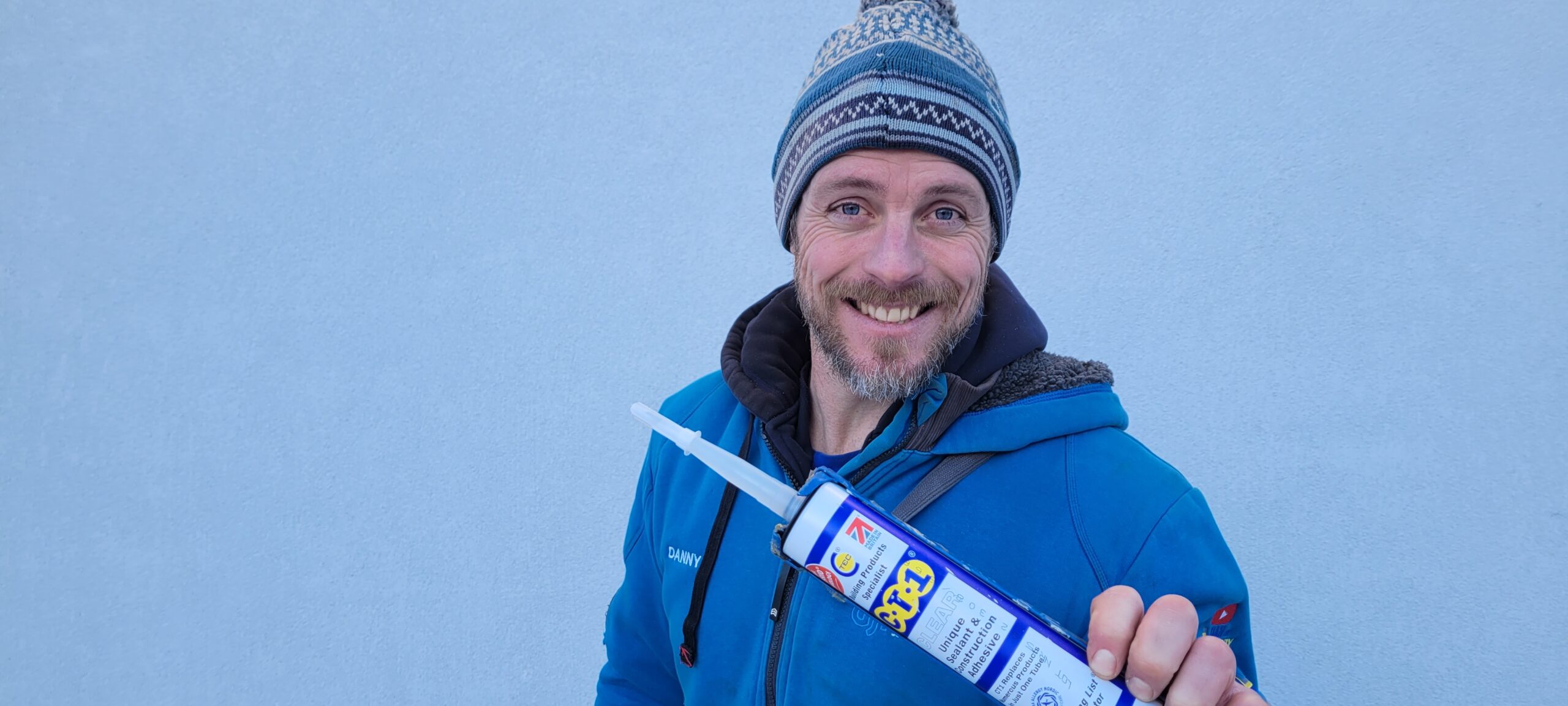
There has been a lot of debate online about whether clear CT1 is suitable for outdoor use, particularly when applied in damp conditions.
Much of this discussion is loud, confident and technically confused.
This article explains, in detail:
- What CT1 actually is
- How it differs from silicone
- Why damp conditions matter
- What EN standards are (and are not)
- Why clear CT1 is often wrongly criticised
- When it is and is not the right product to use externally
This is a technical explanation based on manufacturer documentation, industry standards, and real-world trade use not internet opinion.
If you’d like to see this explained visually, including the real jobs that sparked the debate, you can watch the full video here:
▶ Watch the video:
What Is CT1? (And Why It’s Not Silicone)
One of the biggest sources of misunderstanding is the assumption that CT1 behaves like silicone.
It does not.
Traditional Silicone Sealants
Silicone is primarily a sealant, not an adhesive.
Key characteristics:
- Excellent water resistance
- High flexibility
- Designed to accommodate movement
- Limited structural bonding strength
Silicone works well where:
- The joint is designed to move
- The seal relies on elasticity rather than strength
- Substrates are clean, dry, and well prepared
However, silicone:
- Does not bond materials together
- Relies on surface adhesion only
- Can struggle on damp substrates
- Is not designed for structural or load-sharing repairs
CT1: A Hybrid Polymer Adhesive and Sealant
CT1 is a hybrid polymer, placing it in a completely different category.
Key properties of CT1:
- Designed to bond, not just seal
- Adheres to wet and damp surfaces
- Cures in poor weather conditions
- Remains waterproof once cured
- Retains flexibility without losing bond strength
- Does not shrink during curing
In practical terms:
Silicone seals gaps.
CT1 bonds materials together and seals.
This distinction is particularly relevant in roof repairs and chimney maintenance, where components are often damp and conditions are rarely ideal.
You can see examples of this type of work on our Roof Repairs and Chimney Maintenance pages.
Why Damp Conditions Matter on Real Job Sites
Many construction materials assume ideal conditions.
In reality:
- Roofs are rarely bone dry
- Emergency repairs cannot wait for perfect weather
- Moisture is often unavoidable, particularly at chimney heads and roof junctions
Traditional materials such as cement-based mortars and epoxies often require dry substrates to cure correctly. This is one reason failures occur around chimney pots, flaunching, and roof penetrations.
CT1 is engineered specifically to overcome this limitation.
According to the manufacturer, CT1:
- Can be applied to wet surfaces
- Can cure even underwater
- Remains waterproof after curing
This makes it a practical option for certain external repairs carried out as part of chimney repair work, especially where temporary weather protection or drying time is limited.
Where the Confusion Comes From: EN Standards
Most criticism of clear CT1 does not come from widespread failures.
It comes from EN standards documentation and how that documentation is misunderstood.
What Are EN Standards?
EN standards (European Norms) are testing and classification frameworks.
They exist to:
- Standardise how products are tested
- Allow fair comparison between manufacturers
- Provide documentation for compliance and liability
- Support architects, specifiers, insurers, and regulators
EN standards are primarily about:
- Paperwork
- Declared performance
- Specific test conditions
They are not trade rulebooks and not guarantees of success or failure in every situation.
What EN Standards Are NOT
EN standards do not mean:
- A product will fail outside its declared category
- A product cannot be used elsewhere
- A product becomes unsuitable for all other applications
They describe what the manufacturer has formally tested and declared, not every valid real-world use.
EN 15651 and CT1: The Key Misunderstanding
When CT1 is criticised online, the standard most often referenced is EN 15651, which covers sealants for non-structural building joints, including façade joints.
Under EN 15651:
- Products are classified for interior or exterior façade use
- Movement capability is tested
- Climate exposure is defined
Important distinction
- CT1 Clear and Silver are declared as F-INT (interior façade)
- CT1 Coloured variants are declared as F-EXT-INT-CC (exterior/interior, cold climate)
This has led to the incorrect conclusion that:
“Clear CT1 is not suitable for outdoor use.”
What this actually means
Clear CT1 is not certified for high-movement exterior façade joints under EN 15651.
That is a specification and compliance issue, not a statement that the product fails outdoors.
For typical roof repair or chimney maintenance tasks — which involve static joints rather than façade expansion joints — this distinction is often misunderstood.
Why This Matters for Roof and Chimney Repairs
The types of work shown in the video and discussed here include:
- Sealing around chimney pots and cowls
- Bonding or sealing static roof components
- Repairs where movement is minimal and predictable
These are not façade expansion joints and are not normally subject to façade movement classifications.
In these scenarios:
- Product behaviour matters more than façade certification
- Adhesion to damp substrates is critical
- Weather resistance and flexibility are key
This is why CT1 is frequently used in roof repair work and as part of chimney maintenance and repair, where conditions are often far from ideal.
UV Resistance and Outdoor Durability
Another common claim is that clear CT1 breaks down outdoors due to UV exposure.
According to the manufacturer:
- CT1 Clear is UV resistant
- It is designed to retain clarity
- It is resistant to weathering
In many roof-level applications:
- The adhesive line is partially sheltered
- Direct UV exposure is limited
- UV is not the primary failure mechanism
As with any product, incorrect preparation or misuse can lead to failure — but colour alone does not determine outdoor durability.
Shelf Life vs Service Life: A Common Mix-Up
CT1 has a shelf life:
- Typically around 18 months unopened
- This refers only to storage in the cartridge
This has no connection to how long CT1 lasts once applied and cured.
Once in service:
- Manufacturers do not give fixed “years of life”
- Longevity depends on exposure, movement, and application quality
What is stated is that CT1 is:
- Long-lasting
- Weather resistant
- Designed for demanding environments
This places it firmly in the category of multi-year external performance products, not temporary fillers.
A Balanced Professional Position
For clarity:
- Where formal EN 15651 exterior façade certification is required, the coloured CT1 variants are the correct choice.
- For external bonding and sealing, particularly in damp conditions and static joints commonly found in roof and chimney work, clear CT1 is suitable when used correctly.
Understanding context is the difference between professional judgement and internet argument.
Conclusion: Separating Standards from Reality
Much of the criticism aimed at clear CT1 comes from:
- Confusing standards classification with real-world performance
- Treating EN documentation as a rulebook rather than a test framework
- Applying façade movement logic to non-façade repairs
Clear CT1 is not “unsuitable for outdoor use”.
It is a hybrid polymer adhesive and sealant designed to perform where many traditional products struggle especially in damp conditions typical of roof and chimney repairs.
You can watch the full video explanation here:
▶ https://youtu.be/g4czwb0oBWc
Related Services
Sources and Research Basis
The information in this video and accompanying article is based on a combination of manufacturer documentation, European standards frameworks, and established trade practice. Product-specific details about CT1, including its hybrid polymer chemistry, wet-surface adhesion, UV resistance, and intended use, are taken from official C-TEC / CT1 product literature and technical descriptions published by the manufacturer (https://www.ct1.com and https://shop.ct1.com). Discussion around standards classification refers primarily to EN 15651 (Sealants for non-structural joints in buildings), using the manufacturer’s published Declarations of Performance (DoP) for CT1 Clear, Silver, and coloured variants, which outline how each product is formally classified for façade use under harmonised European standards. Broader explanations of what EN standards are and how they are intended to be used are based on guidance from the European Committee for Standardization (CEN) and the UK/European conformity framework, which governs CE and UKCA marking. Finally, real-world application context reflects accepted trade use in roofing, chimney maintenance, and external repair work, where material choice is informed by site conditions, substrate behaviour, and practical performance rather than paperwork alone.
About the Author
Danny Iwanejko is the owner of DJI High Access Services Ltd, specialising in roof repairs, chimney maintenance, and high-level access work across Nottinghamshire and the surrounding areas. With hands-on experience working at height using specialist access equipment, Danny regularly deals with real-world repair conditions where materials, weather, and access constraints all play a role in how work is carried out. He publishes educational videos and articles to explain practical roofing and chimney issues, materials, and methods in a clear, experience-led way. This article has been edited and curated by Danny to provide accurate, trade-relevant context around product use, standards, and real-world application rather than theoretical or purely specification-led guidance.
Follow Danny Across the Internet
Danny regularly shares behind-the-scenes roofing and chimney work, high-access problem solving, and educational trade content across multiple platforms:
- Website: https://www.dji-uk.co.uk/
- YouTube: https://www.youtube.com/@dan_cherrypicker_man
- Instagram: https://www.instagram.com/dan_cherrypicker_man/
- TikTok: https://www.tiktok.com/@dan_cherrypicker_man
- Facebook: https://www.facebook.com/dancherrypickerman
- X (Twitter): https://x.com/Dan_Picker_Man
- LinkedIn: https://www.linkedin.com/in/danny-iwanejko-18574265/?skipRedirect=true