Chimney removal sounds straightforward on paper… take it down, tile over it, job done.
But as with most roof repairs and chimney work, the reality is never quite that simple.
On this job in Basford, Nottinghamshire, I’m removing a chimney stack below roof level and making it disappear completely into the roofline. What should be a clean, efficient job quickly turns into a lesson in working at height, problem-solving, and adapting on the fly.
👉 Watch the full video here before diving in:
https://youtu.be/K4kzXjZdhu4
Access Is Everything on Chimney Jobs
One of the biggest factors in any chimney repair or removal is access.
In this case, I was able to get my spider lift straight through to the back garden, which made life a lot easier. Using cherry picker access means:
- Safer working conditions
- Faster setup compared to scaffolding
- Better positioning for awkward chimney locations
If you’re dealing with a difficult-to-reach chimney or roof issue, having the right access equipment makes a massive difference. It’s why I offer dedicated 👉 cherry picker access services for jobs just like this.
The Plan: Remove the Chimney and Tile Over
The goal here was simple:
- Take the chimney down below roof level
- Remove all flashings and redundant materials
- Rebuild the roof structure
- Tile over so it looks like the chimney was never there
This kind of work often ties into broader 👉 chimney maintenance and repair services, especially where chimneys are no longer in use or causing leaks.
Trying a New System for Debris Removal
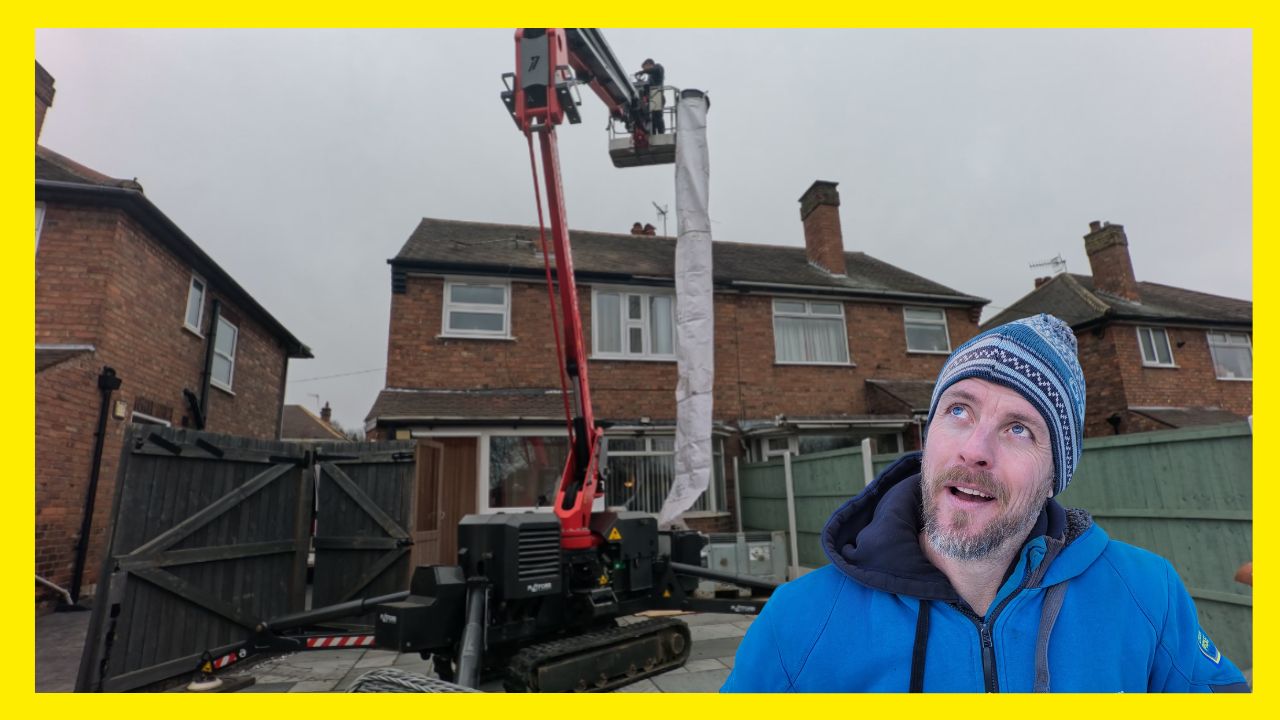
To make things safer and more efficient, I decided to use a canvas chute system to bring the bricks down from the chimney.
In theory:
- Bricks go into the chute
- Travel safely to the ground
- Get collected and cleared quickly
In practice… well, it worked — but not perfectly.
The Problem No One Talks About
The issue came from something most people wouldn’t even think about, the roof pitch and position of the chimney.
Because the chimney sat further back on the roof:
- The chute didn’t clear the tiles properly
- Bricks started catching the eaves
- Some slid across the roof before dropping
Result?
- A few broken tiles
- Gutter removed to avoid damage
- That horrible sound of bricks scraping across a roof (never a good sign)
This is exactly the sort of thing that separates real-world roofing from theory. It’s also why experience matters when dealing with roof leak repairs and chimney work, small details can create bigger problems quickly.
Adapting the Approach (This Is Where Experience Comes In)
Rather than forcing a system that wasn’t quite right, I changed approach.
Instead of dropping bricks directly:
- I loaded them into the basket in small batches
- Stayed within the safe working load
- Positioned above the eaves
- Dropped them cleanly down the chute
It slowed things down slightly, but:
- Prevented further damage
- Made the process controlled
- Actually worked far better overall
That’s the reality of working at height, you adapt to the job, not the other way around.
Removing the Chimney and Associated Fixtures
Once the flaunching was off (often the trickiest part), the rest of the chimney came down methodically.
Other elements removed included:
- Old TV aerial and cables
- Lead flashings
- Redundant materials around the stack
All of this is common during chimney repairs, especially when dealing with older properties where multiple additions have built up over time.
Rebuilding the Roof Properly
With the chimney gone, the focus shifted to rebuilding the roof.
This involved:
- Removing irregular tiles
- Installing new battens flush with the existing structure
- Tiling over the area to match the rest of the roof
Interestingly, this roof had no membrane, so there was no point adding one just in this section. It’s a good example of why roof repairs should always match the existing system, not just follow a generic rulebook.
If you’re dealing with similar issues, whether it’s a leak, damaged tiles, or structural work, it’s worth looking at 👉 professional roof repair services to make sure it’s done correctly.
The Reality of Finishing Work
Of course, no job is complete without a bit of “character building” at the end.
- GoPro battery died (standard)
- Every row needed cuts (also standard)
- Nothing quite lined up as easily as planned
But in the end?
You’d never know there had been a chimney there at all.
And that’s the goal.
Final Thoughts
This job is a perfect example of what real roofing work looks like:
- Plans don’t always go perfectly
- Small details can cause bigger issues
- Experience and adaptability make the difference
It also highlights why proper chimney repairs, roof leak investigations, and high-access work shouldn’t be taken lightly.
👉 If you haven’t already, watch the full job here:
https://youtu.be/K4kzXjZdhu4
Frequently Asked Questions
How do you remove a chimney safely?
Chimney removal is typically done by taking it down brick by brick, starting from the top, while ensuring safe access and controlled debris removal. Using cherry picker access can make the process safer and more efficient, especially on hard-to-reach roofs.
What causes roof leaks around chimneys?
Roof leaks around chimneys are often caused by failed lead flashing, cracked flaunching, or deteriorated mortar joints. Proper 👉 chimney repair services can resolve these issues before they lead to internal damage.
Can a cherry picker access tight spaces?
Yes, tracked spider lifts are designed to fit through narrow access points and work on delicate surfaces. If access is limited, a 👉 cherry picker hire service can often reach areas that scaffolding cannot.
How much does chimney removal cost in the UK?
Costs vary depending on access, chimney size, and roof complexity. Jobs requiring specialist access equipment or additional roof repairs will typically be higher, but every job is different.
Do you need to add membrane when repairing a roof?
Not always. If the existing roof doesn’t have membrane, adding it in one small section can be unnecessary or even ineffective. A proper 👉 roof repair approach should match the existing roof structure.
Follow Me Online:
• 🌐 Website: www.dji-uk.co.uk
• 🎥 YouTube: @dan_cherrypicker_man
• 🎵 TikTok: @dan_cherrypicker_man
• 📸 Instagram: @dan_cherrypicker_man
• 👍 Facebook: Dan the Cherry Picker Man
• ⭐ Google Business Page: DJI High Access Services – Google Search
• 🛒 Amazon Shop: https://www.amazon.co.uk/shop/danthecherrypickerman?ref_=cm_sw_r_cp_ud_aipsfshop_0H3MM4YGDVAPRTXQJAYV_1
My workwear is sponsored by Granite Workwear, and all of the clothing I’m wearing in the video can be purchased on their website: Workwear Clothing Supplier | Protective Safety Clothes
About the Author
Danny Iwanejko is the editor and driving force behind DJI High Access Services, a Nottinghamshire-based business specialising in high-access roof repairs, chimney work, and maintenance.
Working under the name Dan the Cherry Picker Man, Danny combines hands-on roofing experience with specialist access equipment, using spider cherry pickers to safely carry out work that would otherwise be difficult, time-consuming, or unsafe to reach. His day-to-day work includes everything from chimney repairs, repointing, and flaunching, through to roof leak investigations, tile replacement, and gutter clearance.
Danny shares real jobs, honest insights, and practical lessons from the roof through his YouTube channel and blog, giving homeowners and tradespeople a genuine look at what actually goes into roofing work — including the parts that don’t always go to plan.
When he’s not working at height, he’s usually planning the next job, testing new equipment, or documenting life as the Cherry Picker Man.