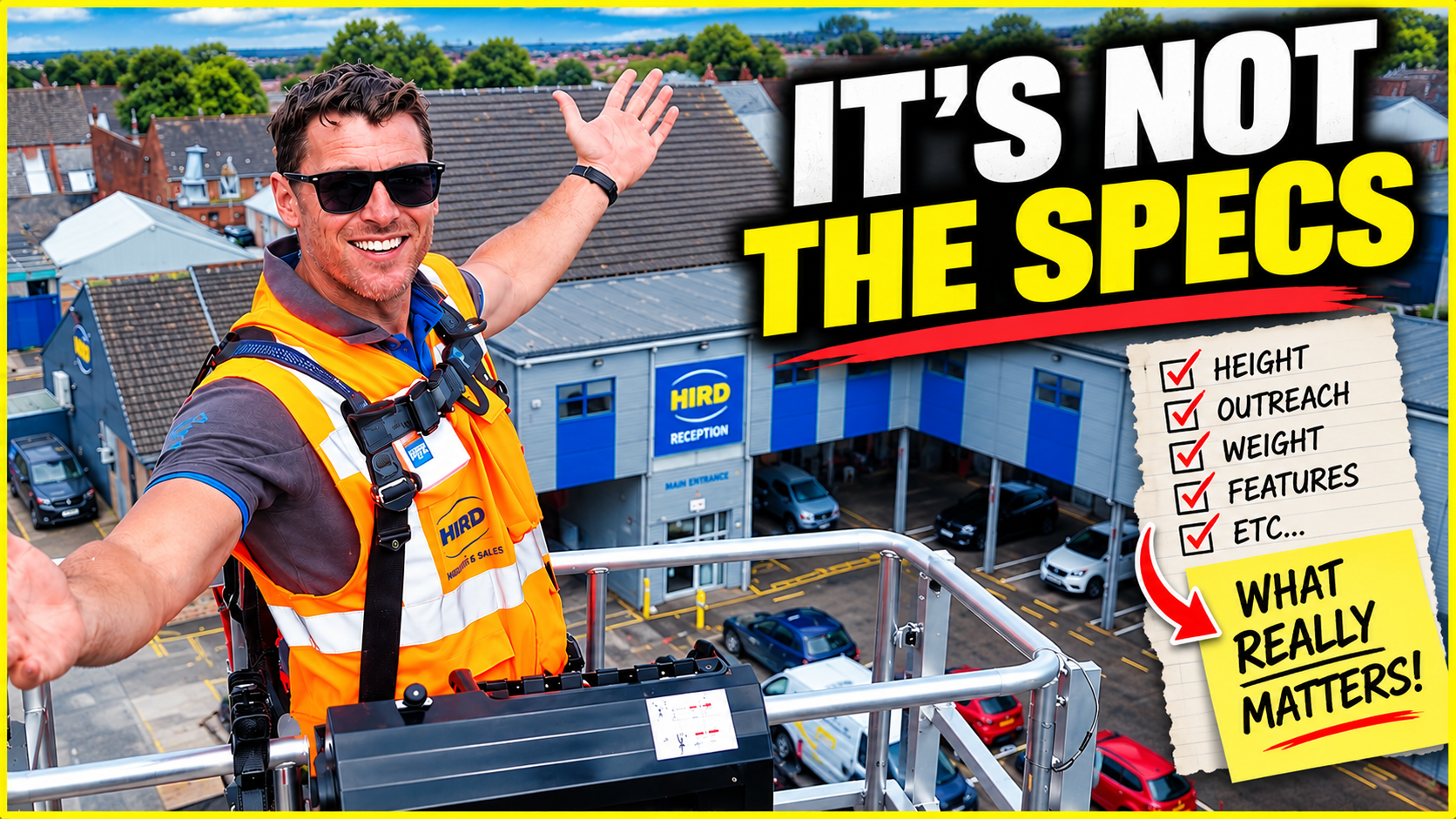
When people look at cherry pickers, there’s a tendency to assume that bigger automatically means better. More height, more outreach, bigger booms – surely that means a more capable machine?
Not necessarily.
When your bread and butter is roof repairs, chimney repairs and other high-access work on domestic properties, having a machine capable of reaching the moon isn’t much use if you can’t get it onto the driveway.
For me, the sweet spot has always been a machine that combines decent working height and outreach with a compact footprint. It needs to get into awkward places, set up where space is limited and still give me the up-and-over capability to reach chimneys on the opposite side of a roof.
That was exactly what I went to Hull to investigate when I visited Herd to get my hands on the Oil & Steel Octo Plus 21, a 21-metre tracked spider lift.
And rather than spending the entire day driving it around a yard and reading numbers from a brochure, I eventually got the opportunity to do something much more useful – take it onto a genuine domestic property and carry out a real chimney inspection.
Watch the full Oil & Steel Octo Plus 21 review on YouTube here:
Oil & Steel Octo Plus 21 – Full Video Review
Have a watch, then come back, because there are a few things about this machine – and buying cherry pickers generally – that are worth discussing in a little more detail.
Bigger Isn’t Always Better With a Spider Cherry Picker
I’ve been operating cherry pickers for around 15 years, and one thing experience teaches you is that the biggest number on a specification sheet isn’t necessarily the most useful number.
A machine can have tremendous working height, but can you actually get it where you need it?
Domestic roofing is a perfect example.
My work regularly involves accessing chimneys, rooflines and gutters from driveways, gardens and other confined spaces. That’s why choosing the correct form of cherry picker access can make such a difference on high-access jobs.
The Octo Plus 21 immediately interested me because it combines a 21-metre working height with a genuinely compact tracked chassis.
The tracks can retract to just 785mm wide, making the machine narrow enough to travel through a standard doorway.
That’s a serious advantage.
Getting a spider lift into position is often half the battle. If the chimney is at the back of a house and the only route there is through a narrow gateway or passage, another metre of working height isn’t going to help you if the machine physically won’t fit through the gap.
Testing the Oil & Steel Octo Plus 21 Controls
Once I’d had a look around the machine, it was time to get onto the controls.
One thing that stood out was how much thought Oil & Steel appears to have put into making the machine understandable for the operator.
The remote gives you control over the outriggers, basket, tracks, automatic levelling and the machine’s various additional functions.
There are three drive speeds, and the individual outriggers can also be operated separately.
More interestingly, the machine’s display doesn’t simply throw a mysterious fault code at you and leave you scratching your head.
If a fault occurs, the screen can display information about it and provide a QR code linking you to the relevant manual information on your phone.
That might sound like a small detail, but anyone who earns money with machinery will understand why it matters.
Downtime costs money.
When you’re running a one-man business and your machine is fundamental to carrying out the day’s work, anything that helps diagnose a problem quickly is valuable.
A Spider Lift That Can Set Up on Difficult Ground
The Octo Plus 21’s outrigger system is another interesting part of the machine.
According to the demonstration, it can level itself on slopes of up to 20 degrees.
That’s useful because real jobs aren’t carried out on perfectly level exhibition floors.
You get sloping driveways, uneven gardens, awkward banks and changes in ground level. The ability to deal with those situations can make the difference between completing a job from a cherry picker and needing an entirely different access solution.
That versatility is one reason I use tracked cherry pickers for so many roof repair jobs. They allow me to get close to the actual problem and inspect areas properly rather than trying to make judgements from twenty feet below.
Up-and-Over Reach Matters for Chimney Repairs
One of the most important tests for me was the machine’s up-and-over capability.
The Octo Plus 21 has a Z-boom arrangement, telescopic boom and fly jib, and these can work together to get the basket into some very useful positions.
This matters enormously when carrying out chimney work.
It’s not simply a question of reaching the height of the chimney.
You might have the cherry picker set up on the front driveway while the chimney is sitting near the ridge or towards the rear elevation. You therefore need enough height to clear the roof and enough horizontal reach to travel across it.
Then the fly jib gives you additional positioning ability once you’re there.
For jobs involving chimney maintenance and repairs, that flexibility can be far more useful than simply having a massive headline working-height figure.
What Does 10.6 Metres of Outreach Actually Mean?
This is where reading the specification properly becomes important.
The Octo Plus 21 can achieve 10.6 metres of horizontal outreach, but that figure doesn’t apply with the basket loaded to its maximum capacity.
At 10.6 metres, the basket capacity is 150kg.
Increase the load to 200kg and the maximum outreach reduces to approximately 10 metres.
Load the basket to its full 250kg capacity – enough for two operators and equipment – and the outreach comes back to around 9.5 metres.
There’s nothing inherently wrong with that. Plenty of access machines trade outreach against basket load.
The important thing is understanding it.
If you need 10.5 metres of outreach to reach a particular chimney, seeing “10.6 metres” on a brochure and assuming you’ve got 100mm to spare could leave you with an expensive problem when you arrive on site carrying two people and a basket full of tools.
Real-world capability matters more than headline figures.
What Does the Octo Plus 21 Feel Like at Full Height?
Naturally, if somebody hands me a 21-metre cherry picker, I’m going to take it to 21 metres.
The boom functions are quick without feeling uncontrollable, and the machine gets you where you want to go without hanging around.
More importantly, it felt solid.
At full height and full reach, you become very aware of how a machine behaves underneath you. Some machines can make you feel slightly uneasy as everything starts moving around.
The Octo Plus 21 felt reassuringly planted.
The controls were also intuitive enough that I could feather the movement and bring the basket smoothly to a stop.
And from 21 metres above Hull, the view wasn’t bad either.
Wall Climb – A Feature I’ve Never Seen Before
This was probably the most unusual feature on the machine.
Oil & Steel calls it Wall Climb.
You position the basket alongside a wall or another straight vertical surface, set the distance you want to remain from it and activate Wall Climb mode.
From there, one lever moves the basket vertically while the machine automatically coordinates the different boom functions required to maintain the same distance from the wall.
Normally, travelling vertically alongside a building requires you to coordinate several boom movements yourself.
Here, the machine does the work.
For somebody carrying out window cleaning, external painting or façade maintenance, I can immediately see the attraction.
You’ve effectively got one hand controlling your vertical movement while your other hand remains free to work.
It’s one of those features that doesn’t necessarily jump out from a conventional specification sheet, but once you see it working, its purpose becomes obvious.
Return to Home and Return to Work
The Octo Plus 21 also has Return to Home and Return to Work functions.
Return to Home automatically brings the machine back down.
Return to Work is particularly interesting.
You can save your working position, return to the ground – perhaps because you’ve forgotten a tool, which obviously never happens… – and then have the machine take you back to the saved position.
For a one-man operation, I can see genuine value in that.
When I’m carrying out a roof survey and inspection, I may be moving around a chimney identifying defects, photographing different elevations and checking the condition of brickwork, mortar, flaunching and leadwork.
Anything that makes repositioning easier without compromising operator control is useful.
Why 420-Degree Slew Is More Useful Than It Sounds
Another specification that might not immediately grab your attention is the machine’s 420-degree slew.
A complete rotation is 360 degrees, so the Octo Plus gives you another 60 degrees beyond a full circle.
Why does that matter?
Because sometimes you’ll reverse a spider lift into an awkward setup position, slew towards the roof and discover that you’re just short of the angle you need.
On a machine with a more restricted slew, you may have to rotate all the way back around in the opposite direction.
That additional 60 degrees can eliminate the problem.
It’s another example of the difference between specifications that look good on paper and features that make sense once you’ve spent enough time doing real work from cherry pickers.
One Thing I’d Change – Give Me a Fuel Gauge!
No machine is perfect.
And I did manage to discover one omission on the Octo Plus 21.
There’s no fuel gauge.
That means checking the diesel needs to become part of your morning routine.
If you don’t, the first indication that you’re running low might be the engine stopping while you’re in the air.
Fortunately, the machine has an emergency lowering system that can bring the basket safely back towards the ground in the event of engine failure – or in the event of the operator being daft enough to run it out of diesel.
After 15 years of operating these machines, though, I’d much rather rely on proper daily checks than emergency systems.
Walk around the machine. Check the obvious things. Check the fuel. Look for damage and anything that doesn’t seem right.
A few minutes at the beginning of the day can prevent considerably more hassle later.
The Most Important Part of Buying a Cherry Picker Isn’t the Machine
This became the real theme of my visit.
I’ve travelled around the country testing quite a few spider lifts now, and there’s something I’ve gradually realised.
Most good machines within the same category are actually quite similar.
One might have slightly more outreach. Another has a cleverer control system. One is lighter. Another has better up-and-over capability.
There are compromises everywhere.
Eventually, the specification sheets start looking remarkably similar.
So what separates them?
The company standing behind the machine.
That becomes very important when your cherry picker is responsible for earning your living.
If it develops a fault on Monday morning, you’re not particularly interested in how impressive the brochure looked when you bought it.
You want somebody to answer the phone.
Looking Behind the Machine at Herd
That was one reason I wanted to visit Herd rather than simply review the Oil & Steel machine in isolation.
Herd is a family-run business based in Hull and is the UK distributor for Oil & Steel.
The company has experience across access equipment, lifting, machinery moving, mini cranes and training, with depots covering different areas of the UK and engineers operating on the road.
More importantly from an owner’s perspective, their engineers are trained on Oil & Steel equipment and have support extending back to the manufacturer in Italy.
If an engineer encounters a problem that can’t immediately be diagnosed, the machine can be connected through a laptop and further technical support can be provided remotely.
That sort of backup matters.
A cherry picker isn’t a toy. For an owner-operator, it is a piece of capital equipment that needs to go out and earn money.
Having the right support network behind it could ultimately prove more valuable than gaining another few centimetres of outreach.
You can see the machine, my full test and the conversation about Herd’s backup and support in the complete video:
Watch my full Oil & Steel Octo Plus 21 review on YouTube
Putting the Octo Plus 21 on a Real Chimney Survey
This was probably my favourite part of the visit.
Rather than finishing the review in Herd’s yard, Dan arranged for me to take the Octo Plus 21 to his daughter’s house nearby.
She had a problem with her chimney, so we loaded the machine, transported it over and set it up on the driveway.
Perfect.
Because that’s precisely how I use these machines.
It was a proper domestic driveway rather than a huge open yard, and I had an actual chimney to inspect.
Once I got up there, I discovered there was indeed a genuine leak and identified a couple of real problems with the chimney.
For me, that test tells you far more about a machine than driving around an immaculate yard.
A substantial part of my own work involves investigating roof leaks and chimney problems where the cause isn’t always obvious from ground level. Getting close enough to inspect the masonry, flaunching, mortar joints, leadwork and surrounding roof can completely change the diagnosis.
That’s also why I believe proper access is so important with roof leak repair.
Guessing from the ground can get expensive very quickly.
Why Roof and Chimney Surveys Matter
Water getting into a property around a chimney doesn’t automatically mean there’s one obvious crack that needs filling.
Possible causes can include deteriorated pointing, cracked or failed chimney flaunching, defective lead flashing, porous masonry, damaged roof coverings or a combination of several defects.
The advantage of close inspection is being able to determine what’s actually happening before deciding what needs repairing.
The same principle applies elsewhere on a roof.
Whether I’m investigating a chimney leak, broken tile or gutter cleaning and clearance problem, getting proper access to the affected area allows me to see what’s actually happening rather than simply treating the most obvious symptom.
My Verdict on the Oil & Steel Octo Plus 21
So, would I be happy using the Octo Plus 21 for the type of high-access roofing and chimney work I carry out?
Yes.
It’s well built, straightforward to operate and felt solid both at height and at maximum outreach.
The 785mm minimum width makes it particularly interesting for domestic access, while the up-and-over capability, fly jib and 21-metre working height give it the reach required for some genuinely awkward properties.
The Wall Climb feature is something I’ve never encountered on another machine and could be extremely useful for certain trades.
Would I change anything?
Yes.
I’d give it a fuel gauge.
But there’s nothing I found during the day that would put me off the machine.
More importantly, the visit reinforced something I’ve increasingly come to believe.
When you’re spending serious money on a spider cherry picker, don’t buy purely from the specification sheet.
Look at the dealer.
Look at parts availability.
Look at engineering support.
Look at what happens when the machine stops working.
Because 21 metres of working height is brilliant – right up until your machine is sitting in the yard with a fault and nobody is answering the phone.
That’s when you discover what you actually bought.
High-Access Roof and Chimney Work
My own cherry picker is used for everything from chimney repointing and chimney flaunching to roof inspections, roof leak repairs, gutter work and other difficult high-access jobs.
For suitable properties, using a tracked spider cherry picker can provide direct access to the problem without surrounding an entire house in scaffolding simply to reach one relatively small area.
It isn’t the answer to every job – no access method is – but when the site and job suit it, it’s an extremely effective way of working at height.
If you’ve got a difficult roof, chimney or gutter problem and you’re wondering whether it can be reached using a cherry picker, you can find more information about my roofing, chimney and high-access services through my website.
And if you enjoy machinery reviews, real roofing jobs and seeing how these machines actually perform outside the showroom, follow me online and subscribe to the YouTube channel. There’s plenty more to come.
Frequently Asked Questions
Can a spider cherry picker get through a standard doorway?
Some tracked spider cherry pickers are specifically designed for restricted access. The Oil & Steel Octo Plus 21 tested in this video can retract its tracks to approximately 785mm wide, making it narrow enough to pass through many standard doorways and tight access routes.
Can a cherry picker be used to inspect a leaking chimney?
Yes, where the property and ground conditions allow safe setup, cherry picker access can be particularly useful for chimney inspections. It allows close examination of brickwork, mortar joints, chimney flaunching, leadwork and surrounding roof coverings without trying to diagnose everything from ground level.
What causes roof leaks around chimneys?
Common causes include deteriorated mortar joints, cracked chimney flaunching, failed or incorrectly installed lead flashing, porous masonry and damaged roof coverings around the stack. A close inspection is often needed before deciding which chimney repairs are actually required.
How do you repair a leaking chimney?
The correct repair depends on where the water is entering. Work might involve chimney repointing, renewing damaged flaunching, repairing lead flashing or dealing with defects in the surrounding roof, so identifying the source should come before carrying out roof repairs.
Is a cherry picker better than scaffolding for roof repairs?
It depends entirely on the property and the work involved. For suitable short-duration roof repairs, chimney work and inspections, a cherry picker can provide very direct access without erecting scaffolding around the property, but some jobs will still require scaffolding or another access method.
What should I look for when buying a spider cherry picker?
Don’t compare machines using working height alone. Consider outreach at different basket loads, machine width, overall weight, outrigger footprint, up-and-over capability, parts availability and, crucially, the engineering and technical support available after you’ve bought it.
Follow Me Online:
• 🌐 Website: www.dji-uk.co.uk
• 🎥 YouTube: @dan_cherrypicker_man
• 🎵 TikTok: @dan_cherrypicker_man
• 📸 Instagram: @dan_cherrypicker_man
• 👍 Facebook: Dan the Cherry Picker Man
• ⭐ Google Business Page: DJI High Access Services – Google Search
• 🛒 Amazon Shop: Dan the Cherry Picker Man Amazon Shop
My workwear is sponsored by Granite Workwear, and all of the clothing I’m wearing in the video can be purchased on their website: Workwear Clothing Supplier | Protective Safety Clothes