In 20 years of working at height, carrying out roof repairs, chimney repairs and all sorts of awkward jobs using cherry picker access, I’ve seen my fair share of questionable brickwork.
But this one was different.
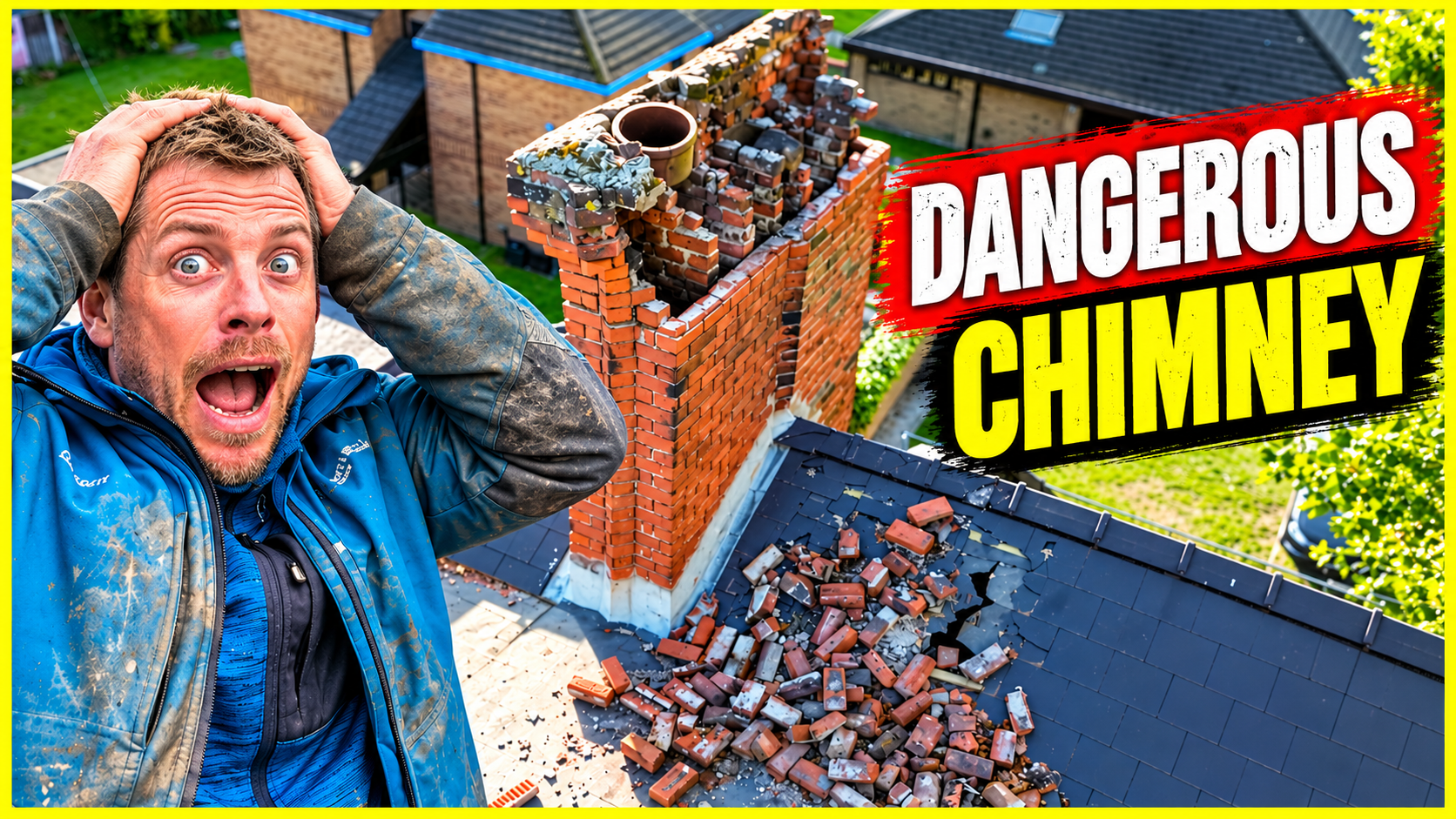
I’d been called over to Hull after a chimney partially collapsed during some particularly bad weather. By the time we arrived, one side of the chimney had already gone, a huge amount of masonry had landed on the roof below, and what remained standing didn’t exactly inspire confidence.
In fact, my opening words in the video pretty much sum it up:
“In 20 years of doing this type of work, I’ve never seen a chimney in such dangerous condition.”
The immediate job wasn’t to rebuild the chimney or carry out the permanent roof repairs. It was much simpler in principle, although considerably trickier in practice:
Get the dangerous section down safely before it came down by itself.
If you want to see the whole job unfold rather than just read about it, you can watch The Most Dangerous Chimney I’ve Seen in 20 Years on YouTube. Have a watch, then come back here because there’s quite a bit worth explaining about how we approached this one.
A Partially Collapsed Chimney and a Badly Damaged Roof
I was working with Mark and Kai from Bricks and Mortar on this job.
The chimney had partially collapsed the previous week during bad weather. A substantial amount of masonry had come down, scattering bricks and rubble across the flat roof and sending more debris down the other side. The falling brickwork had damaged the roof on its way down.
But strangely enough, the bit that had already fallen wasn’t our biggest concern.
It was the bit that hadn’t.
There was still a substantial amount of masonry standing at the top of the chimney, and it was clearly unstable. Neither Mark nor I particularly liked the idea of somebody erecting scaffolding directly underneath it while there was a chance that another section could come crashing down.
That was where the cherry picker came in.
For this particular stage of the job, powered access allowed us to approach the chimney without first putting somebody directly underneath the unstable brickwork. It’s a good example of why the right form of cherry picker access can be so useful for unusual working-at-height problems.
Assessing the Chimney Before Touching Anything
The first thing we did was get up there and assess what we actually had.
When something is already partially collapsed, you don’t want to start swinging a hammer at it and hope for the best. Removing one apparently insignificant brick can change how the remaining structure is supported.
That was particularly important here.
Half of the chimney was already gone, leaving a tall and very precarious section behind. Our concern was what I described in the video as a “Jenga effect”: take the wrong brick out and suddenly a much larger section could let go.
And unlike Jenga, losing this game involves considerably more paperwork.
This is also why inspection is such an important part of roofing and chimney work. Not every problem is as spectacular as this one. Often, deteriorating mortar joints, damaged chimney flaunching, failed flashing or cracked masonry can be identified much earlier through a proper roof survey and inspection.
Catching deterioration before several hundred bricks decide to relocate themselves onto the roof is generally preferable.
Using Netting to Control the Unstable Brickwork
After looking at the chimney, Mark suggested wrapping the remaining section in netting.
We covered the unstable masonry with green netting and secured it around the chimney with a ratchet strap. The thinking was straightforward: if something unexpectedly broke away while we were dismantling it, hopefully the netting would contain at least some of the masonry rather than allowing bricks to scatter uncontrollably across the roof or fall to the ground.
It wasn’t foolproof, and we never pretended it was.
It also made physically removing the bricks more awkward.
But that was a trade-off we were happy to make because it gave us an additional degree of control.
And, as it turned out, the netting did actually catch falling bricks during the dismantling.
The Moment a Section Started to Collapse
This was the part that justified all the caution.
We were slowly dismantling the upper section when I removed a brick from around the rear corner.
Suddenly, it felt as though a much larger section was about to go.
I managed to grab hold of it, and thankfully Mark was alongside me because quite a substantial lump of masonry came away together. Instead of allowing it to crash onto the flat roof, I held it while Mark helped break it down with a lump hammer into smaller, manageable pieces.
That moment illustrates the problem with badly deteriorated chimney stacks.
From ground level, a chimney might look like it needs some straightforward chimney maintenance and repair — perhaps chimney repointing, new flaunching or repairs to the leadwork. Once deterioration progresses far enough, however, you can be dealing with something very different.
In this case, we were well beyond routine chimney repointing.
Slowly Bringing the Chimney Down
Once the highest and most precarious section was under control, we could begin working our way down more methodically.
Brick by brick, the remaining chimney was dismantled.
As the pile of masonry on the flat roof grew, another consideration became important: weight.
We couldn’t simply keep piling bricks onto the roof, nor could we overload the cherry picker basket.
So we developed a fairly repetitive routine.
Remove some bricks. Build a manageable pile. Load an appropriate amount into the basket. Lower it to the ground. Empty it. Go back up.
Repeat.
And repeat.
And repeat again.
It wasn’t quick, but quick wasn’t the objective.
The objective was control.
Slow and Steady Wins the Race
That became the theme of the whole job.
As I explain in the video, speed wasn’t the priority. We wanted to keep everything as controlled as possible and avoid causing any more damage.
Slow and steady wins the race.
When you’re working at height with unstable masonry, there is very little benefit in saving ten minutes if doing so substantially increases the chances of dropping a brick through somebody’s roof.
This is one of the realities of high-access roof repair work. Sometimes the actual repair or dismantling isn’t particularly complicated. The difficult bit is creating a safe, controlled way of reaching the problem and carrying out the work without causing another one.
You can see that whole process in the full collapsed chimney video here.
Getting the Chimney Down to a Safe Level
Eventually, we reached the point where the dangerous section was gone.
We deliberately left the remaining brickwork a few courses above ridge height. That gave us something substantial enough to temporarily cover with membrane and secure down.
The intention was not to pretend we’d completed the permanent repair.
We hadn’t.
Our job that day was to make the chimney safe.
The remaining chimney would eventually need rebuilding properly, and that stage required scaffolding rather than a cherry picker.
That distinction matters.
Cherry pickers are incredibly useful pieces of equipment, and they allow me to undertake many chimney repairs, roof leak investigations, gutter repairs and other jobs without scaffolding. But they aren’t automatically the right solution for every stage of every job.
Sometimes scaffolding is the correct tool.
Knowing when not to use a cherry picker is just as important as knowing when to use one.
Temporarily Weatherproofing the Roof
The collapsed chimney had left more than just a pile of bricks behind.
There were holes in the roof where masonry had fallen through and damaged the covering.
Before leaving, we temporarily weatherproofed those areas as well as we reasonably could and capped the remaining chimney with membrane.
Again, this wasn’t being presented as a permanent roof leak repair.
It was temporary protection until the scaffold could be erected and the chimney and roof could be properly reconstructed.
That is another important point with emergency roofing work: sometimes the first visit is about making something safe and preventing the situation getting worse. The permanent repair comes afterwards.
Not a Single Brick Dropped
Considering what we started with, I was particularly pleased with one thing.
We managed to dismantle the dangerous section and bring all the masonry down without dropping any bricks.
Everything was brought down in a controlled manner.
By the time we packed the machine away, the dangerous section of chimney was gone, the debris had been removed, the damaged areas had been temporarily weatherproofed and the site was left clean and tidy. The next stage would be scaffolding and reconstruction, which I’d leave in Mark’s capable hands.
Not a bad result for a Sunday.
And, importantly, we were finished just about in time for Sunday dinner.
What This Job Says About Chimney Maintenance
Obviously, this is an extreme example.
Most chimney repairs don’t begin with half the chimney lying across the roof.
The more common jobs I see involve deteriorated mortar joints requiring chimney repointing, cracked or eroded flaunching around the pots, defective flashing, loose bricks or water getting into the stack.
Those problems don’t necessarily mean a chimney is about to collapse. But they are exactly the sorts of defects worth identifying and addressing before deterioration progresses further.
My work regularly involves chimney inspections, maintenance and repairs, often using cherry picker access where conventional access would otherwise be difficult or expensive.
Likewise, if the source of a roof problem isn’t obvious, a targeted inspection or more comprehensive roof survey can often establish what’s actually happening before anybody starts quoting blindly for repairs.
The aim is always the same: find the problem first, then decide on the sensible way of dealing with it.
Roof Surveys, Chimney Repairs and High-Access Work
Although this particular job took me to Hull to work alongside another contractor, most of my day-to-day work involves high-access property maintenance, roofing and chimney work.
That can include roof surveys, chimney repairs, chimney flaunching, chimney repointing, roof leak investigations, gutter cleaning and repairs, bird protection work and other awkward jobs at height.
Cherry picker access can be particularly useful where scaffolding would be disproportionate for the work required or where a problem needs inspecting before anyone really knows what repair is necessary.
If you’ve got an issue with a chimney or roof and you’re not sure what’s causing it, you can find more information about my roof surveys and reports and the types of high-access work I undertake on my website.
Frequently Asked Questions
What should I do if part of my chimney has collapsed?
Keep people away from the affected area and arrange for the structure to be professionally assessed. A partially collapsed chimney may leave unstable masonry above the roof, so the immediate priority is usually making the area safe before permanent chimney repairs or rebuilding begins.
Can a cherry picker be used for chimney repairs?
Yes, cherry picker access can be very useful for chimney inspections, repointing, flaunching and many other high-level repairs where suitable access and ground conditions are available. On this job, using powered access meant we could approach the unstable chimney without first erecting scaffold directly beneath the remaining masonry.
Does a damaged chimney always need rebuilding?
No. Many chimney problems can be dealt with through chimney maintenance and repair, including repointing, flaunching and some flashing repairs. A badly deteriorated or structurally unstable chimney may require partial or complete rebuilding, depending on its condition.
What causes chimney brickwork to deteriorate?
Chimneys are highly exposed to rain, frost, wind and repeated wetting and drying. Over time, mortar joints, bricks and chimney flaunching can deteriorate, allowing water penetration and potentially contributing to more serious defects if maintenance is neglected.
Can a damaged chimney cause a roof leak?
Yes. Water can enter around failed lead flashing, deteriorated mortar, damaged flaunching or defects where the chimney meets the roof. A proper roof inspection can help distinguish a chimney-related leak from other problems requiring roof repairs.
Do all chimney jobs need scaffolding?
No. Some chimney repairs and inspections can be carried out using cherry picker access, depending on the property, ground conditions and nature of the work. Other jobs, particularly substantial rebuilding work, may be better suited to scaffolding — exactly as was the case with the next stage of this Hull chimney.
Follow Me Online:
• 🌐 Website: www.dji-uk.co.uk
• 🎥 YouTube: @dan_cherrypicker_man
• 🎵 TikTok: @dan_cherrypicker_man
• 📸 Instagram: @dan_cherrypicker_man
• 👍 Facebook: Dan the Cherry Picker Man
• ⭐ Google Business Page: DJI High Access Services – Google Search
• 🛒 Amazon Shop: Dan the Cherry Picker Man Amazon Shop
My workwear is sponsored by Granite Workwear, and all of the clothing I’m wearing in the video can be purchased on their website: Workwear Clothing Supplier | Protective Safety Clothes