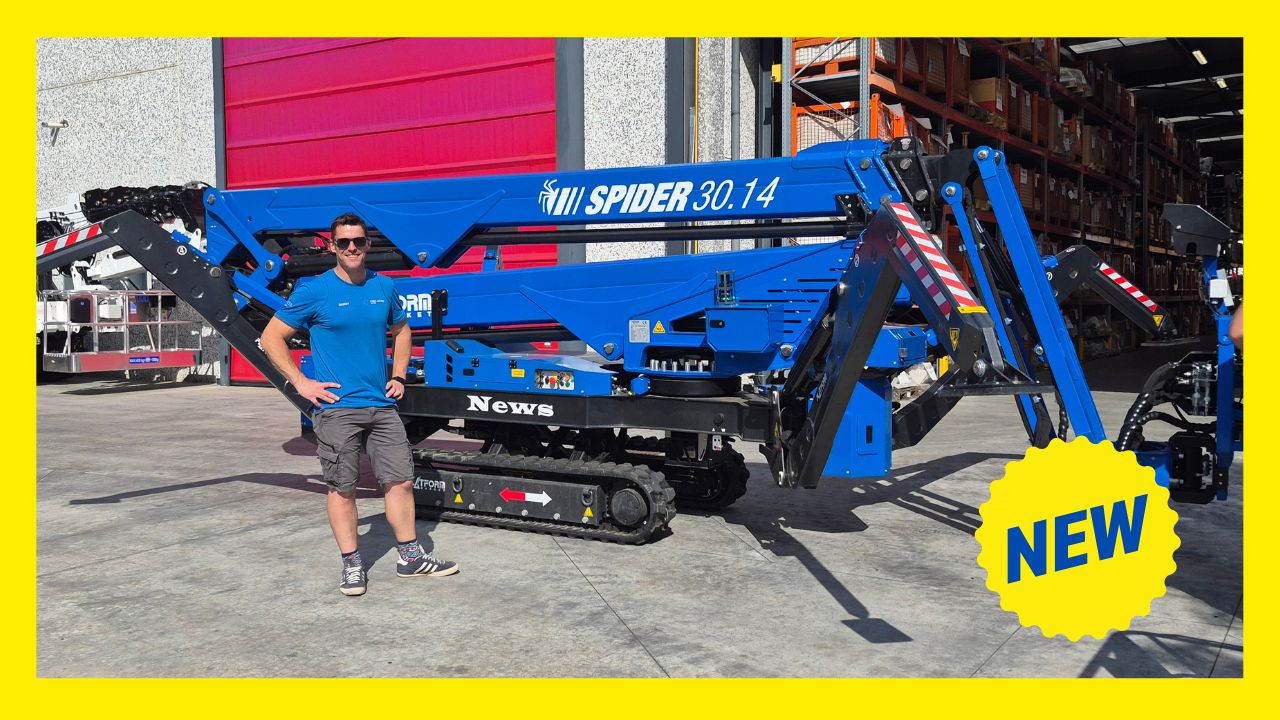
There are machines you review, and then there are machines that stop you in your tracks before you’ve even climbed in. The Platform Basket 3014 was very much the latter. I was in Italy visiting the Platform Basket factory – taking a look around, learning how these machines are put together – when something parked outside caught my eye. Sitting there, fresh off testing, was the very first Platform Basket 3014 prototype ever produced. Not one of hundreds already out on job sites. The first one. Ever.
Naturally, when they asked if I wanted a go, I said yes before they’d finished the sentence.
👉 Watch the full video here: https://youtu.be/1fSE4wkQlQQ
What Is the Platform Basket 3014?
The 3014 is a tracked spider lift that Platform Basket have built to push the boundaries of what a compact access platform can actually do. The headline figures are impressive enough on their own: over 30 metres of working height, 13 metres of lateral outreach, a transport weight of under 4.5 tonnes, and a folded width of under 900mm. It also folds down to under 2 metres in height.
On paper, a machine with those numbers shouldn’t be this compact. That tension between capability and size is exactly what made me want to find out where the compromises were — because with machines like this, there are usually a few hiding somewhere.
Self-Loading and Transport – A Smarter Setup Than Most
One of the first things that stood out was the self-loading system. Rather than using ramps to get the machine on and off a trailer or low loader, the 3014 uses its own stabilisers to lift itself, allowing the trailer to be driven away cleanly underneath it. It works the same way in reverse for loading.
For anyone who moves machines regularly, that’s not a small thing. Ramps are a faff. They take time, they require space, and they introduce a loading risk that the self-loading system simply removes. It also means that in the right setup, you could potentially unstrap the machine and set it up without even moving the trailer — which is a genuinely useful time-saver on a busy site.
That said, in the UK context, the transport realities still apply. A machine of this capability still needs the right vehicle, the right trailer category, and the correct licence class. Anyone thinking about ownership needs to factor all of that into the equation from day one — it’s part of what I’d call the full ownership picture, not just the spec sheet.
Whether you need a machine for a one-off job or you’re thinking about long-term cherry picker access for your site work, it’s worth understanding what the logistical side of high-reach equipment actually involves before committing.
Variable Outriggers – Getting Into Tight Spaces
The variable outrigger system on this machine is one of its most practical features, and it’s one that operators working in restricted environments will immediately appreciate. The machine can be set up in multiple outrigger configurations depending on the space available. Run them fully wide and you unlock the full working envelope. Narrow them down and the machine’s onboard system automatically calculates the adjusted safe working area and limits the boom’s travel accordingly.
You can even run mixed outrigger positions — one side wide, one side narrow — and the machine will work out where the boom is in relation to the footprint and adjust dynamically. For anyone trying to squeeze into a courtyard, a back garden, a narrow alley, or work on one face of a building without room to spread out, that flexibility can be the difference between getting the job done and having to turn the machine around.
With high-access roofing and chimney work, access is often the hardest part of the equation. A machine that can adapt its footprint to the space available is solving a real problem.
The Boom System – More Going On Than You’d Think
The boom arrangement on the 3014 is worth explaining properly because it’s doing quite a lot.
The lower section is effectively a tower boom with a telescopic section built in, taking you up to around 15 metres. Attached to that is a second articulated boom — also with its own telescopic section — which brings you to roughly 27 metres when fully extended upward. A fly jib on the end delivers the final movement and takes the machine to just over 30 metres working height.
For anyone carrying out roof repairs or chimney work, fly jibs are genuinely useful. Those final small adjustments — getting over a ridge line, reaching past a parapet wall, easing yourself down the other side of a roofline — are exactly the kind of movements that make the difference between working comfortably and constantly fighting your position.
The Up and Over Capability
What I found particularly useful about the way this boom is designed is the up and over reach it creates. The first tower boom lifts you to around 15 metres. From there, the second articulated boom can continue upward, work across, or drop down through its movement range into the negative. Combined with the fly jib, that gives you a genuinely flexible working shape — not just height, but geometry.
For roofing and chimney work specifically, height alone often isn’t enough. You need shape. You need to get up and over obstacles and then lower yourself back down to exactly where you’re working. This machine does that well.
Working in the Negative
Another feature worth highlighting is the machine’s ability to work below ground level — what’s called working in the negative. Because the tower boom can be raised and the second telescopic boom then used to reach back down toward the ground, you can access points below the machine’s standing level without having to reposition the entire setup.
Practically, this opens up work on bridges, retaining walls, embankments, and elevated platforms where you need to reach downward rather than upward. It’s one of those features that doesn’t sound exciting until you’ve tried to do that kind of work on a machine that can’t do it.
Basket Rotation and Positioning
The basket on the 3014 rotates through approximately 70 degrees, and the turret rotates through 180 degrees. That combination gives you meaningful adjustment once you’re working at height — and anyone who’s spent a day trying to work square onto a chimney stack from a machine that won’t quite get you into the right position will know exactly why that matters.
Without basket rotation, you’re either repositioning the machine repeatedly, reaching across yourself, or leaning over guardrails in ways that aren’t ideal. Small adjustments at height make a disproportionate difference to both working comfort and productivity over the course of a full day.
There’s also an autofold function — press the button and the machine stows itself back into transport configuration. Useful if you’re new to the machine, and a nice touch from a practical standpoint.
The Crane Attachment – A Genuine Surprise
👉 If you haven’t watched the video yet, this bit is worth seeing: https://youtu.be/1fSE4wkQlQQ
Part way through the demonstration, the Platform Basket team removed the basket entirely and fitted a winch attachment in its place. The 3014 is capable of lifting up to 250 kg as a lifting crane.
It’s worth being clear: lifting operations come with significant additional responsibilities around training, planning, and safe working procedures. This isn’t something to approach casually, and I’m not suggesting anyone should simply start using a spider lift as a crane without the correct controls in place. But from a versatility standpoint, having one compact machine capable of both high-access work and controlled lifting operations is a genuinely interesting proposition — particularly for specialist access contractors or companies building out a multi-function fleet.
My Honest Assessment
After spending time with this machine, what stood out most wasn’t just the height or the outreach — it was the fact that Platform Basket have managed to build something genuinely big that can still behave like something much smaller. A 30-metre spider lift that folds to under 900mm wide and can squeeze through a standard doorway is not a normal machine.
The variable outrigger system, the up and over boom geometry, the negative reach capability, the basket rotation, the crane attachment — none of these feel like features bolted on for the brochure. They feel like considered engineering decisions made by people who understand how this kind of machine actually gets used.
For someone like me, personally, there are still practical considerations around transport and logistics that would need working through before a machine of this size became part of my setup. That’s not a criticism of the 3014 — it’s just honest ownership thinking. But as a first prototype, this is a seriously impressive piece of kit.
Platform Basket haven’t just built a bigger spider lift. They’ve built a bigger spider lift that can get into places where big machines normally can’t. That’s a meaningful difference.
Frequently Asked Questions
What is a spider lift and how does it differ from a standard cherry picker?
A spider lift is a type of compact tracked access platform that uses extendable stabiliser legs to set up on uneven or restricted ground. Unlike a standard wheeled cherry picker, spider lifts can fold down to very narrow transport widths and set up in spaces where larger machines simply can’t reach. They’re commonly used for roofing, chimney repair, and high-access work in restricted locations.
How high can the Platform Basket 3014 reach?
The Platform Basket 3014 reaches just over 30 metres working height, with 13 metres of lateral outreach. It achieves this through a combination of a telescopic tower boom, a second articulated telescopic boom, and a fly jib — giving it both height and the ability to work over and around obstacles.
Can a spider lift work in tight or restricted spaces?
Yes — that’s one of the core advantages of spider lift design. The Platform Basket 3014 folds down to under 900mm wide and under 2 metres tall, meaning it can pass through most standard doorways and access areas that conventional cherry picker platforms couldn’t get near. The variable outrigger system also lets operators reduce their setup footprint where space is limited.
What does working in the negative mean on an access platform?
Working in the negative means the machine’s boom can reach below the level of the machine itself — useful for bridge inspections, retaining walls, embankments, or any situation where you need to access a point that’s lower than where the machine is standing. Not all spider lifts offer this capability, and it significantly expands the range of access problems a machine can solve.
Can a spider lift be used as a crane?
The Platform Basket 3014 can be fitted with a winch attachment in place of the basket, giving it a 250 kg lifting capacity. However, lifting operations require proper training, risk assessment, and safe working procedures. It’s not a feature to use without the correct knowledge and controls in place, but for specialist operators it represents a significant versatility advantage.
How do I know if a spider lift is right for my job?
It depends on the access required, the working height, and the site conditions. If you’re dealing with restricted entry points, uneven ground, or need to work in confined spaces at significant height, a spider lift is often the most practical solution. If you’re unsure what’s needed for your particular job, a roof survey or site assessment can help identify the right access approach before any work begins.
Follow Me Online
- 🌐 Website: www.dji-uk.co.uk
- 🎥 YouTube: @dan_cherrypicker_man
- 🎵 TikTok: @dan_cherrypicker_man
- 📸 Instagram: @dan_cherrypicker_man
- 👍 Facebook: Dan the Cherry Picker Man
- ⭐ Google Business Page: DJI High Access Services – Google Search
- 🛒 Amazon Shop: https://www.amazon.co.uk/shop/danthecherrypickerman?ref_=cm_sw_r_cp_ud_aipsfshop_0H3MM4YGDVAPRTXQJAYV_1
👕 My workwear is sponsored by Granite Workwear, and all of the clothing I’m wearing in the video can be purchased on their website: Workwear Clothing Supplier | Protective Safety Clothes