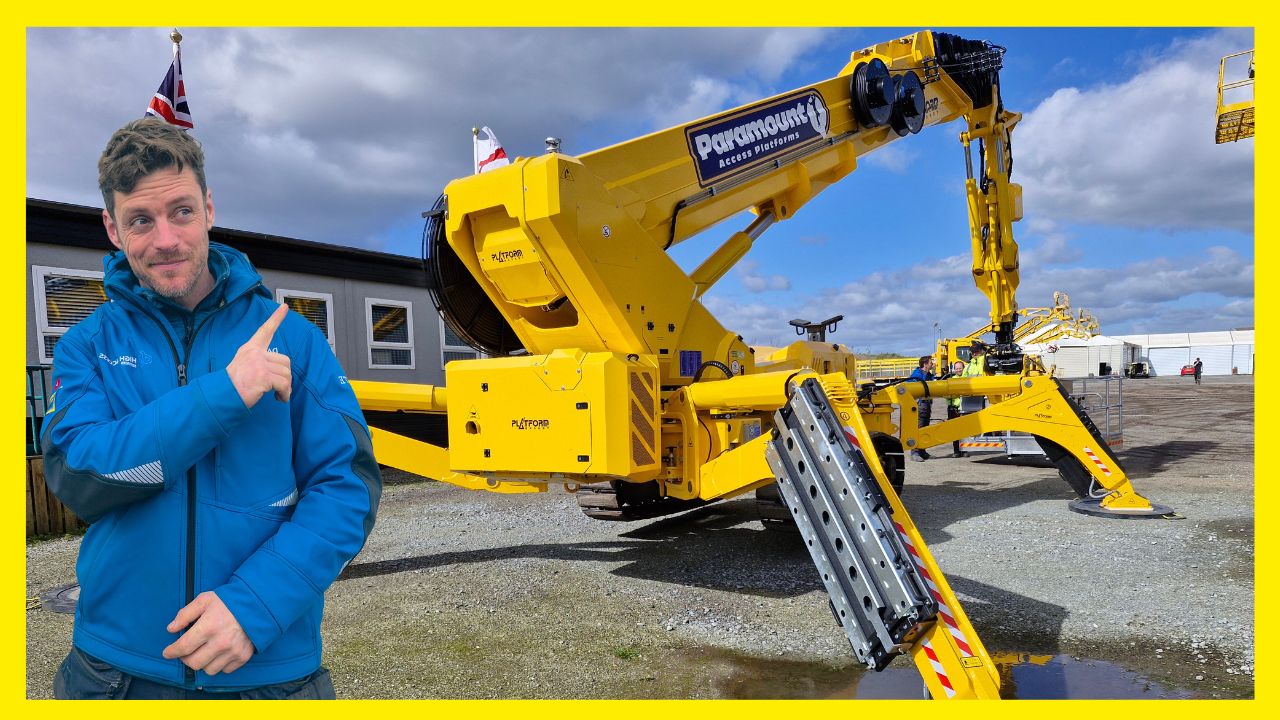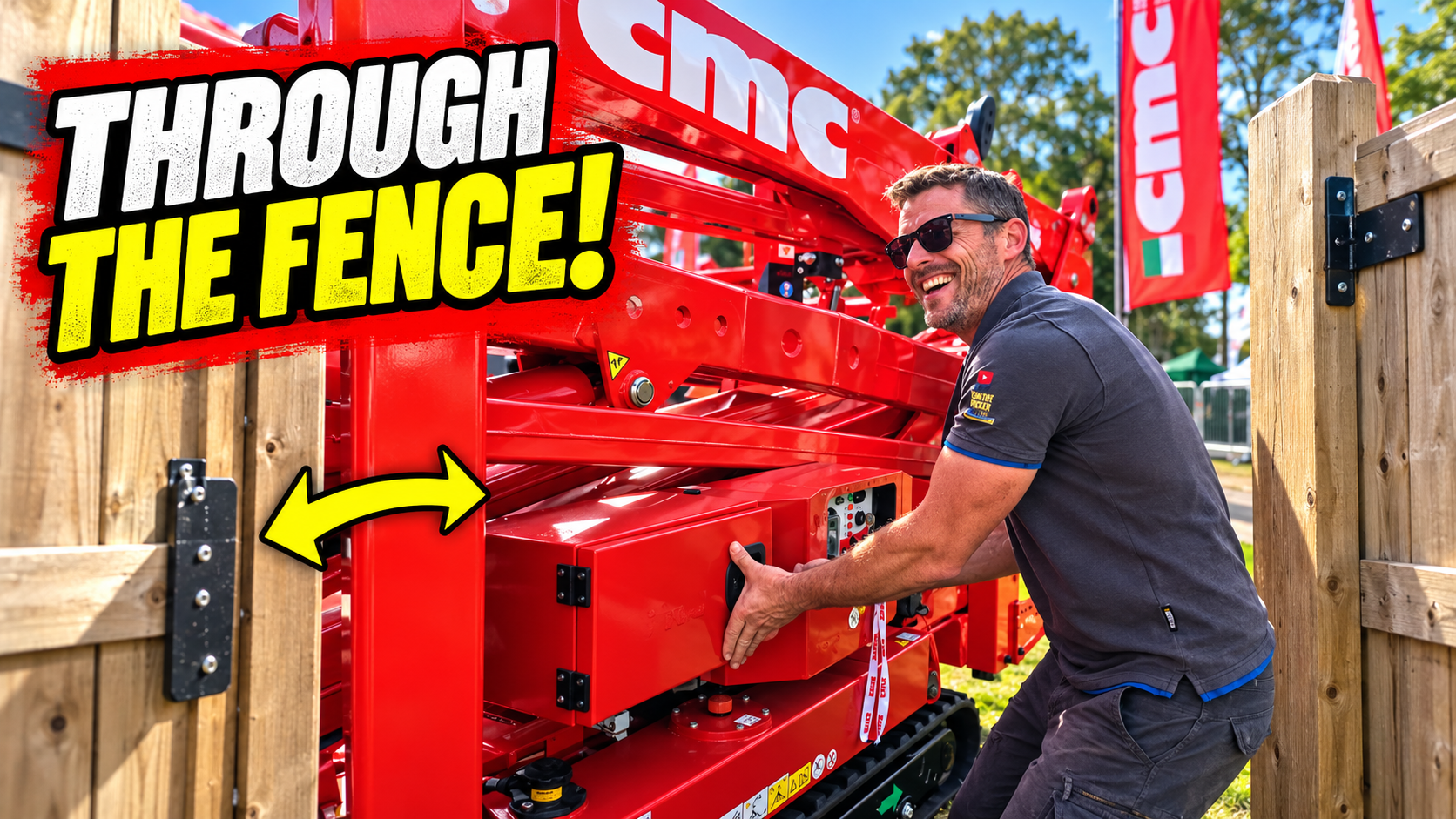
“Caroline, I’m going to put this machine through your fence.”
Probably not the most reassuring sentence to hear when somebody has just been handed the controls of a CMC S20 spider lift.
I was at the CMC stand at APF 2026 when they’d set up a simple demonstration to show just how useful the CMC S20 can be when access gets tight. The challenge was straightforward enough: retract the machine, remove the basket and drive it through a very narrow opening in the fence.
Simple.
Or at least it would have been if I could immediately remember where all the controls were.
What followed was actually a really useful demonstration of something that matters enormously in my own work: getting a capable cherry picker through restricted access to reach places that conventional access equipment simply can’t get to.
That’s particularly relevant to the high-access roofing and chimney work I carry out, where getting the machine from the road to the actual job can sometimes be as challenging as the work at height itself.
You can watch the full CMC S20 narrow-access test here:
https://youtu.be/C_Tuj-zl7Ag
Watch me attempt to get it through the fence, then come back because there are a few interesting details about this machine that are worth looking at properly.
Why Narrow Access Matters With a Spider Cherry Picker
One of the reasons I’ve spent so many years working with spider cherry pickers is their versatility.
Getting 20 metres into the air is one thing. Getting the machine into the position where you can actually use those 20 metres is another matter entirely.
On domestic properties, I regularly encounter narrow driveways, side passages, gateways, extensions, conservatories, gardens and other obstacles. A conventional truck-mounted cherry picker may have the height and outreach required, but if the property prevents you from getting anywhere near the working area, those specifications don’t help much.
A tracked spider lift gives you another option.
This is why specialist cherry picker access can be so useful for awkward properties. Depending on the site and the machine being used, a spider lift can potentially travel through relatively restricted access before being set up closer to the building.
For my work, that can mean getting into position for chimney repairs, roof inspections, gutter cleaning or difficult roof repairs without automatically resorting to scaffolding.
Of course, every site is different. Just because a machine is narrow doesn’t mean it will fit everywhere. Width is only one consideration — ground conditions, gradients, turns, overhead restrictions, setup area and the route through the property all matter.
First Problem: Remembering How the CMC S20 Works
I’ve operated plenty of spider lifts over the years, but that doesn’t mean I can jump onto every different model and instantly know where everything is.
That became apparent fairly quickly.
I started looking for the controls I needed to retract the machine and initially managed to select the wrong thing.
Fortunately, the CMC S20 controls are labelled. If you stop for a second, look at the controller and exercise a little patience, it makes considerably more sense.
Patience isn’t always my strongest quality.
Eventually I found what I needed and started getting the machine into its narrow configuration.
It made a serious point in a fairly light-hearted way:
Machine Familiarisation Is Crucial
Experience with MEWPs and cherry pickers doesn’t remove the need for familiarisation.
Controls, emergency procedures and machine behaviour can vary between manufacturers and models. If you’re going to operate a machine safely, particularly around buildings, fences and other obstacles, you need to understand the machine you’re actually standing in front of.
That becomes even more important when you’re using access equipment commercially and working at height around customers’ properties.
A small mistake at ground level can damage a gate or wall. A mistake once you’re set up next to a roof or chimney can have considerably bigger consequences.
Retracting the CMC S20 for Restricted Access
To get the S20 through the demonstration opening, we needed to bring the outriggers in and narrow the tracks.
We also needed to remove the basket.
There’s a practical lesson here that comes from using these machines in the real world.
If you know the basket has to come off to get through a gateway or narrow passage, get the machine as close to that restricted section as you reasonably can before removing it.
Why?
Because otherwise you’ve got to carry the basket further than necessary.
It sounds obvious, but when you’re concentrating on machine setup it’s very easy to make additional work for yourself.
I use cherry picker access for everything from roof repairs and difficult roof leak investigations to high-level chimney work. When you’re working on your own or with a small team, little decisions like where you remove a basket or unload equipment can make a significant difference over the course of a day.
Driving the CMC S20 Through the Fence
With the tracks narrowed and the basket removed, it was time for the actual challenge.
Russell decided to make things slightly more entertaining by having me stand on the opposite side and bring the machine towards myself.
That meant the tracking controls effectively felt reversed from my position.
Thanks, Russell.
Then came another revelation.
Apparently, it wasn’t a real fence.
There goes the illusion.
Real fence or not, the demonstration still showed something useful about the CMC S20: the tracking is impressively controllable at low speed.
When you’re putting a spider lift through a restricted opening, you don’t want aggressive or jerky movements. You want to be able to make tiny corrections and know how the machine will respond.
The S20 has plenty of torque, but that power is delivered in a way that allows very fine adjustments.
That is exactly what I want from a tracked cherry picker.
Why Smooth Tracking Matters on Real Roofing Jobs
A trade-show demonstration is one thing. A customer’s property is another.
On an actual job there might be a brick wall on one side, somebody’s extension on the other and only a small amount of clearance between them.
There may also be paving, drains, steps, soft ground or landscaping to consider.
That’s why I don’t simply look at the maximum working height of a cherry picker when judging whether it is useful for my business.
I want to know:
- Can I physically get it to the job?
- How accurately can I position it?
- What is it like to track slowly?
- Can it negotiate awkward access?
- How easy is it to set up?
- Can I control it precisely around someone’s property?
Those things matter enormously when the eventual task might be inspecting a leaking chimney, carrying out chimney maintenance and repairs, replacing failed flashing or reaching guttering that can’t safely be accessed by ladder.
Roof Surveys Often Start With the Access Problem
This is also something that comes up regularly when I’m carrying out roof inspections.
Before diagnosing a roof defect, I first need to establish how I can safely get close enough to inspect it properly.
A photograph taken from ground level can only tell you so much.
With suitable access, I can get close enough to inspect mortar joints, chimney flaunching, leadwork, slipped tiles, ridge systems, guttering and other potential defects. That is one of the reasons I offer roof surveys and inspection reports before recommending work where the cause of a problem isn’t obvious.
There is little point guessing at a roof leak from the ground and then pricing a repair based on that guess.
Access equipment allows me to inspect the actual problem.
And sometimes the first problem to solve is simply: how do I get the cherry picker there?
A Small Detail on the CMC S20 That I Initially Missed
Once I’d successfully negotiated the opening, I thought I’d found something to criticise.
Where do you put the controller?
I couldn’t immediately see somewhere convenient to hang it.
Russell, unfortunately for me, had an answer.
CMC has provided a protected storage box within the machine.
Initially that just looked like a sensible way of protecting an expensive controller from falling debris. For somebody doing tree work, roofing or other work where materials could potentially fall, keeping the control unit protected makes complete sense.
But there was more to it than that.
The Emergency Reason for the Controller Storage
Russell explained that the controller’s location is also connected to emergency operation.
Imagine there is nothing mechanically wrong with the machine, but the person in the basket has suffered a medical emergency and can no longer operate it.
Because everyone knows where the control box is stored, it can be retrieved, paired with the machine and used to bring the operator down using the controls rather than immediately having to start dealing with valves and pumps.
That’s the sort of design feature I like.
It isn’t particularly glamorous and probably isn’t the first specification somebody notices when looking at a new spider lift, but in the real world these details matter.
When you’re routinely working at height, emergency procedures shouldn’t be something you start figuring out after the emergency has happened.
Basket Back On – Challenge Completed
All that remained was to put the basket back onto the CMC S20.
Being a relatively new machine, it required a little persuasion to locate properly.
Apparently after a few years it’ll practically fall back on.
Eventually everything was back where it belonged.
I asked what I’d won.
Naturally, I was hoping the answer might be a CMC S20.
I’m still waiting.
Most importantly, though, the machine successfully made it through the opening and Caroline’s fence remained intact.
I’d call that a successful demonstration.
If you haven’t watched it yet, you can see the complete CMC S20 narrow-access challenge on YouTube here:
What I Took Away From the CMC S20 Demonstration
The obvious point of the demonstration was to show that the CMC S20 can be configured for narrow access.
But there were several things I found more interesting than simply watching a machine fit through a gap.
The first was the quality of the tracking. Being able to make small, smooth adjustments matters enormously when you’re operating close to buildings and obstacles.
The second was another reminder that machine familiarisation matters regardless of experience.
And the third was the thought that’s gone into details such as the protected controller storage and emergency operation.
I spend a lot of my working week using cherry pickers to reach roofs, chimneys and guttering where conventional access can be difficult. Whether I’m investigating a leak, carrying out chimney flaunching or repointing, or undertaking high-level gutter clearance, the access method is a fundamental part of planning the job.
A machine doesn’t just need impressive numbers on a specification sheet.
It needs to work in the real world.
And quite often, before it can go up, it needs to be able to squeeze through.
Using Cherry Pickers for Roof and Chimney Work
For homeowners, the important point isn’t necessarily which particular machine I use.
It’s that specialist access equipment can sometimes provide a practical alternative when a roof, chimney or gutter is difficult to reach.
My day-to-day work includes roof surveys, roof leak investigation and repair, chimney repointing, chimney flaunching, gutter cleaning and other high-access property maintenance.
Where appropriate, using a spider cherry picker means I can get close to the work, inspect the problem properly and carry out repairs without automatically requiring a full scaffold installation.
That doesn’t mean a cherry picker is right for every property. Sometimes access simply isn’t possible, and sometimes scaffolding genuinely is the better solution.
The important thing is choosing the access method to suit the job rather than trying to force the job to suit the access method.
Frequently Asked Questions
Can a spider cherry picker fit through narrow access?
Many spider lifts are specifically designed with restricted access in mind and may have retractable tracks, folding or removable baskets and compact travelling dimensions. The actual route still needs assessing for width, height, turns, gradients and ground conditions, but specialist cherry picker access can open up properties that larger access platforms cannot reach.
Why do you remove the basket from a spider lift?
On some spider cherry pickers, removing the basket reduces the machine’s travelling dimensions and allows it to negotiate narrower openings. I prefer to get the machine close to the restricted access point before removing the basket so it doesn’t need carrying further than necessary.
Can you use a cherry picker for roof repairs?
Yes, where site conditions and the nature of the work make a MEWP suitable, cherry pickers can provide excellent access for inspections and certain roof repair jobs. Every property needs assessing individually because safe positioning, ground conditions, outreach and the required working area all affect whether cherry picker access is appropriate.
Can a cherry picker be used for chimney repairs?
Cherry pickers can be particularly useful for chimney repointing, chimney flaunching, leadwork repairs and close-up inspections where suitable access and setup are available. My chimney maintenance and repair work often benefits from being able to position the basket close to the chimney rather than trying to diagnose defects from ground level.
Why is machine familiarisation important for cherry picker operators?
Even experienced operators need to familiarise themselves with a particular MEWP because control layouts, emergency procedures and machine behaviour vary between models. Understanding the machine before beginning work is an important part of safe and controlled working at height.
Is a cherry picker better than scaffolding for roof work?
Neither is automatically better. A cherry picker can be quicker and less intrusive for certain inspections and repairs, while scaffolding may be more appropriate for longer-duration work, properties with unsuitable machine access or jobs requiring a larger continuous working platform.
Follow Me Online:
• 🌐 Website: www.dji-uk.co.uk
• 🎥 YouTube: @dan_cherrypicker_man
• 🎵 TikTok: @dan_cherrypicker_man
• 📸 Instagram: @dan_cherrypicker_man
• 👍 Facebook: Dan the Cherry Picker Man
• ⭐ Google Business Page: DJI High Access Services – Google Search
• 🛒 Amazon Shop: https://www.amazon.co.uk/shop/danthecherrypickerman?ref_=cm_sw_r_cp_ud_aipsfshop_0H3MM4YGDVAPRTXQJAYV_1
My workwear is sponsored by Granite Workwear, and all of the clothing I’m wearing in the video can be purchased on their website: Workwear Clothing Supplier | Protective Safety Clothes